Understanding FXSwap
FXSwap is a specialized Automated Market Maker (AMM) designed for uncorrelated but low-volatility asset pairs (such as Forex pairs crvUSD and EURC). It leverages the mathematical efficiency of Stableswap within the dynamic rebalancing framework of Cryptoswap, along with some new innovations.
As with all Curve AMM pools, providing liquidity in FXSwap is completely passive. All liquidity is full-range (no active range management required), so anyone can participate easily.
Why FXSwap?
Cryptoswap pools are designed to be entirely self-sufficient, relying on trading volumes and swap fees to naturally rebalance liquidity around the market price. This model works well for assets where the Cryptoswap pool is the dominant liquidity pool for tokens, and where price discovery happens (e.g., CVX, YB, RSUP, etc).
However, for asset pairs where price discovery is mostly happening elsewhere, (e.g., forex, BTC, ETH, etc) the pool needs to quickly rebalance and stay balanced around the current market price. This is why FXSwap pools were created.
FXSwap does this by introducing Refuels. This mechanism allows projects to "fast-track" the rebalancing process using external incentives rather than waiting for accumulated trading profits. This ensures the pool remains efficient and balanced around the current price even during periods of low volatility.
Note: As FXSwap architecture is derived from these two predecessors, we recommend reviewing their documentation first. See Stableswap explainer and Cryptoswap explainer.
How it works
FXSwap was created to provide efficient, fully passive forex-style liquidity on-chain. It achieves this by taking specific components from its predecessors:
- Stableswap Invariant: To keep spreads tight, FXSwap utilizes the Stableswap invariant for pricing. This is ideal for assets where liquidity should remain highly concentrated near the current oracle price.
- Hybrid Rebalancing: Like Cryptoswap, up to 50% of trading fees are used to rebalance liquidity. However, FXSwap introduces a Refuelling mechanism. Refuels act as an external buffer to cover rebalancing costs, protecting LP profitability and ensuring faster price alignment.
- Dynamic Fees: The pool utilizes a dynamic fee model, increasing fees during periods of high volatility and imbalance to protect LPs and capture value.
Let's look at how an FXSwap pool prioritizes these resources while moving liquidity:
You can see from the video above that if refuels are available, they are used first, however a small amount of profit is always consumed.
Recommended Assets
Because FXSwap pools utilize donations to maintain efficiency, they are best suited for highly liquid assets with lower relative volatility.
It is generally not recommended to use FXSwap for primary price discovery. For example, YieldBasis utilizes FXSwap for its BTC/crvUSD pools (established assets tracking external prices), but uses a standard Cryptoswap pool for YB/crvUSD (the primary market for its governance token).
Refuels
Refuels are LP tokens deposited into the pool specifically to subsidize rebalancing. The core premise is that liquidity is deepest when it's balanced, therefore, more balanced liquidity attracts higher volumes and profits for LPs; therefore, Refuels are an expense that is offset by higher aggregate returns for LPs.
Refuels are similar to market making fees, however instead of requiring trusting a third party, refuels are completely transparent for your team and LPs, keeping the pool balanced, and trustlessly optimizing liquidity depth and slippage for traders of your asset.
Key Mechanics:
- Open Access: Refuels can be added by anyone.
- Vesting Period: Deposits are initially locked and unlock linearly over a set duration (default is 7 days, configurable via
donation_duration) to prevent immediate depletion. - Priority Usage: Unlocked Refuels are the "first line of defense." They are consumed to recenter liquidity before the protocol taps into LP trading fees. This ensures the pool offers optimal swap rates faster, generating more volume and profits.
- Efficiency: The introduction of Refuels allows the pool to trigger rebalances on smaller price movements, keeping the peg tighter than standard pools.
How much do Refuels cost?
Three main factors influence the cost of Refuels:
- Volatility: Higher volatility requires more frequent rebalancing.
- Liquidity Concentration (
A): HigherAvalues create deeper liquidity, but increase the cost to move that liquidity when prices change. - Swap Fees: Higher volume generates more fees. Since 50% of fees are used for rebalancing, high-volume pools require fewer external Refuels.
Case Study: YB Pools (BTC/crvUSD) Data analyzed for ~45 days after TVL reached $100M.
- TVL: ~$100M per pool
- Total Fees Paid: ~$86k / day
- Swap Fees used to Rebalance: ~$43k / day (50% of total fees)
- Refuels Consumed: ~$10k / day
- LP Returns (Net): ~$43k / day (~12% APY)
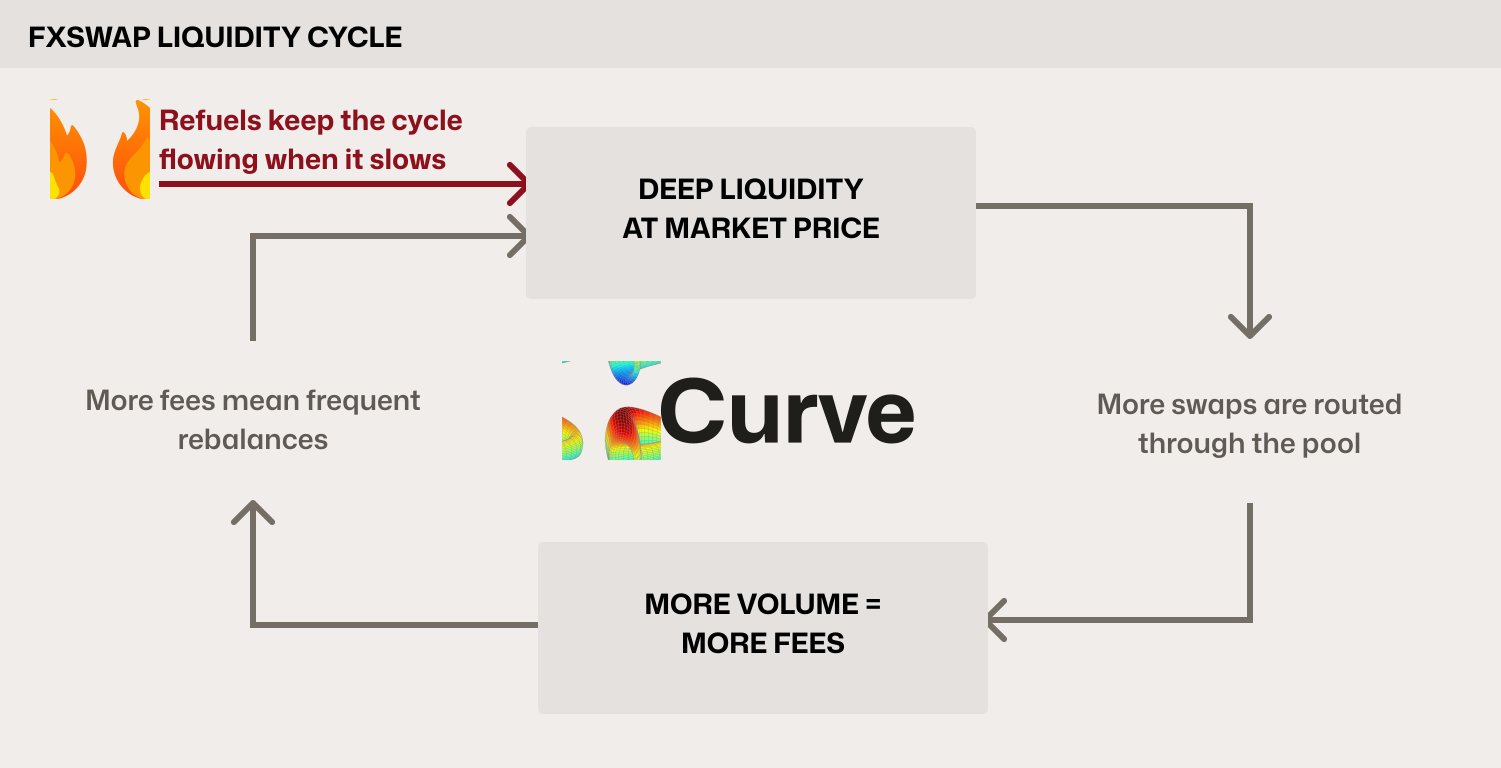
In this scenario, Refuels represent only 3.6% of TVL per year (approx. 23% of total rebalancing costs), while enabling deep liquidity that created massive fee generation. This feeds into the FXSwap liquidity cycle:
How Can I Refuel a Pool?
Refuels are deposited via the standard add_liquidity function. A community UI is available at: crvhub.com/refuel
To set up recurring automated refuels, use the Donation Streamer — deposit tokens once and have them streamed into the pool on a schedule.
Can I add another Refuel while one is unlocking?
Yes. FXSwap pools track the total refuel amount within an unlock period (default 7 days) and calculate a continuous unlock rate.
Example (with 7 day unlock time):
-
Day 0: A $700 refuel is added, unlock rate: $100/day.
-
Day 3: $300 has been consumed; $400 remains.
-
Day 3: A new $1400 refuel is added.
- New Total: The total refuels for this period is now $700 (old) + $1400 (new) = $2100.
- New Rate: The total of $2100 unlocked over 7 days is a rate of $300/day, this is the new rate.
- New State: Total remaining is $400 (old) + $1400 (new) = $1800.
-
Day 4-9: The $1800 remaining refuels unlock at a rate of $300/day.
Can I use FXSwap without Refuels, or use Refuels only as a last resort instead of a Cryptoswap pool?
Yes, but be aware that FXSwap pools use the simpler Stableswap invariant (no gamma), so there is less fine tuning of the liquidity bonding curve available.
Parameters
Amplification Factor (A)
The amplification factor in FXSwap pools works similarly to the amplification factor in Stableswap pools, with one key distinction: the liquidity centers around a variable called price_scale rather than a fixed 1.0 peg.
Let's have a look at what this means in terms of balance in the pools and prices:
Gamma (gamma)
Gamma is unused in FXSwap logic. While the parameter exists in the smart contract ABIs, it is retained solely for backward compatibility, allowing integrators to use existing Cryptoswap patterns to interface with FXSwap pools.
Dynamic Fees
Dynamic fees adjust based on the pool's balance. Fees are lower when a swap helps balance the pool, and higher when a swap unbalances it. This is controlled by three parameters:
- Mid Fee: The base fee charged when the pool is perfectly balanced (e.g., 50/50 value ratio).
- Out Fee: The maximum fee, charged when the pool is entirely tilted toward one asset.
- Fee Gamma: Controls the steepness of the fee increase. A lower gamma results in a sharper rise from Mid Fee to Out Fee as imbalance grows.
Below you can see how these three parameters affect the shape of the dynamic fee that will be charged based on the value ratio of assets in a pool (e.g., $550k in ETH and $450k in crvUSD equals a 55/45 value ratio)